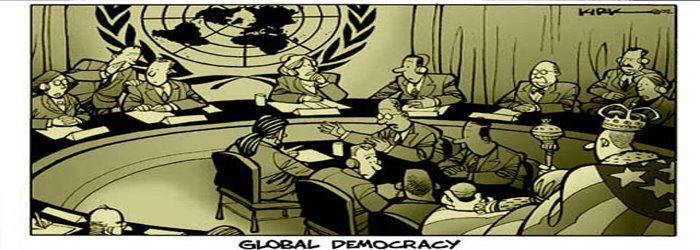
I read a very good article that was published by Peter Brookes at The New York Post back in 2006 that addressed all the critics out there of America and her so called 'agenda' etc., etc., etc. The article is entitled 'A World Without America". Enjoy.
A World Without America
By Peter Brookes
For all the worldwide whining and bellyaching about the United States, today - America's 230th birthday - provides an opportune time for them to consider for just a moment what the world might be like without good ol' Uncle Sam.
The picture isn't pretty. Absent U.S. leadership, diplomatic influence, military might, economic power and unprecedented generosity, life aboard planet earth would likely be pretty grim, indeed. Set aside the differences America made last century - just imagine a world where this country had vanished on Jan. 1, 2001.
On security, the United States is the global balance of power. While it's not our preference, we are the world's "cop on the beat," providing critical stability in some of the planet's toughest neighborhoods.
Without the U.S. "Globo-cop," rivals India and Pakistan might well find cause to unleash the dogs of war in South Asia - undoubtedly leading to history's first nuclear (weapons) exchange. Talk about Fourth of July fireworks . . .
In Afghanistan, al Qaeda would still be an honored guest, scheming over a global caliphate stretching from Spain to Indonesia. It wouldn't be sending fighters to Iraq; instead, Osama's gang would be fighting them tooth and nail from Saudi Arabia to "Eurabia."
In Asia, China would be the "Middle Kingdom," gobbling up democratic Taiwan and compelling pacifist Japan (reluctantly) to join the nuclear weapons club. The Koreas might fight another horrific war, resulting in millions of deaths.
A resurgent Russia, meanwhile, would be breathing down the neck of its "near abroad" neighbors. Forget the democratic revolutions in Ukraine and Georgia, Comrade! In Europe, they'd be taking orders from Paris or Berlin - if those rivals weren't at each other's throats again.
In Africa, Liberia would still be under Charles Taylor's sway, and Sudan would have no peace agreement.
And what other nation could or would provide freedom of the seas for commerce, including the shipment of oil and gas - all free of charge?
Weapons of mass destruction would be everywhere. North Korea would be brandishing a solid nuclear arsenal. Libya would not have given up its weapons, and Pakistan's prodigious proliferator, A.Q. Khan, would still be going door to door, hawking his nuclear wares.
Also missing would be other gifts from "Uncle Sugar" - starting with 22 percent of the U.N. budget. That includes half the operations of the World Food Program, which feeds over 100 million in 81 countries.
Gone would be 17 percent of UNICEF's costs to feed, vaccinate, educate and protect children in 157 countries - and 31 percent of the budget of the U.N. High Commissioner for Refugees, which assists more than 19 million refugees across the globe.
In 2005, Washington dispensed $28 billion in foreign aid, more than double the amount of the next highest donor (Japan), contributing nearly 26 percent of all official development assistance from the large industrialized countries.
Moreover, President Bush's five-year $15 billion commitment under the Emergency Plan for AIDS Relief is the largest commitment by a single nation toward an international health initiative - ever - working in over 100 (mostly African) countries.
The United States is the world's economic engine. We not only have the largest economy, we spend 40 percent of the world's budget on R&D, driving mind-boggling innovation in areas like information technology, defense and medicine.
We're the world's ATM, too, providing 17 percent of the International Monetary Fund's resources for nations in fiscal crisis, and funding 13 percent of World Bank programs that dole out billions in development assistance to needy countries.
And what does Uncle Sam get in return? Mostly grief, especially from all the ungrateful freeloaders who benefit tremendously from the global "public goods" we so selflessly provide with our time, effort, blood and treasure. How easily - and conveniently - they forget . . . unless they need help, of course.
But let us never forget, especially today, that despite the name-calling, the jeers, the petty jealousies, we're the envy of the world - and rightfully so.
The fact is that no matter what anyone says: No country has given so much to so many so often - while asking for so little in return - for so little gratitude than this great country of ours. So Happy birthday, America! Stand tall and proud - you've earned it.
Peter Brookes is a columnist for The New York Post , a Heritage Foundation senior fellow and author of "A Devil's Triangle: Terrorism, WMD and Rogue States."
Wednesday, 1 December 2010


Sunday, 14 March 2010
Is America in decline, or about ready to move to the next level?
Every contrarian bone I have in my body tells me that America is about ready to enter a new era of worldwide expansion on a grand scale, considerably necessitated by self-interest and quite possibly as a pre-requisite to behind the scenes political and diplomatic demand from those nations who fear current rising great powers who do not aspire to their cultural goals and ideals.
However, as noted in many publications, newscasts, university lectures, etc., America seems to be riding the path to insignificance that has plagued many other regional and world powers in the past, including the Greeks, Romans, Chinese (who are supposedly ready to take over), Byzantinians, and the English/British, to name a few.
Notwithstanding the negative 'press' concerning Americas certain decline, my thinking is inspired by many sources, including investment strategy used by many of the most successful money moguls on the planet. An example of this ideology can be illustrated by paraphrasing the investment doctrine of the great Warren Buffet, the worlds premier buyer and seller of everything, as he elaborates on the above mentioned contrarian ideology by stating, 'You pay a very high price in the stock market for a cheery consensus', and this would tell me that the opposite must also be true in that the current global morosity concerning America is evidence that it is ready to soar.
Your thoughts would be very much appreciated, Anson
References:
http://www.investopedia.com/articles/financial-theory/08/contrarian-investing.asp
The Modern Scholar: The Tiber and the Potomac: Rome, America, and Empires of Trust
Thomas F. Madden
http://www.economist.com/blogs/freeexchange/2010/01/roots_american_dominance
http://www.guardian.co.uk/commentisfree/2008/sep/28/usforeignpolicy.useconomicgrowth
http://blogs.telegraph.co.uk/news/alexspillius/9363517/Obama_signals_the_end_of_American_dominance/
However, as noted in many publications, newscasts, university lectures, etc., America seems to be riding the path to insignificance that has plagued many other regional and world powers in the past, including the Greeks, Romans, Chinese (who are supposedly ready to take over), Byzantinians, and the English/British, to name a few.
Notwithstanding the negative 'press' concerning Americas certain decline, my thinking is inspired by many sources, including investment strategy used by many of the most successful money moguls on the planet. An example of this ideology can be illustrated by paraphrasing the investment doctrine of the great Warren Buffet, the worlds premier buyer and seller of everything, as he elaborates on the above mentioned contrarian ideology by stating, 'You pay a very high price in the stock market for a cheery consensus', and this would tell me that the opposite must also be true in that the current global morosity concerning America is evidence that it is ready to soar.
References:
http://www.investopedia.com/articles/financial-theory/08/contrarian-investing.asp
The Modern Scholar: The Tiber and the Potomac: Rome, America, and Empires of Trust
Thomas F. Madden
http://www.economist.com/blogs/freeexchange/2010/01/roots_american_dominance
http://www.guardian.co.uk/commentisfree/2008/sep/28/usforeignpolicy.useconomicgrowth
http://blogs.telegraph.co.uk/news/alexspillius/9363517/Obama_signals_the_end_of_American_dominance/
Wednesday, 24 September 2008

Saturday, 13 September 2008
Palin Response to Gibson and Bush Doctrine Question
I thought Governor Palin's initial response to Gibson's question concerning the definition of the Bush doctrine was insightful in regards to the fact that there is not a single answer to the question. The Bush Doctrine has been defined as several different foreign policy ideologies over his administration including philosophies on preventative war, pre-emptive war, the spread of democracy, and so on. Therefore, when she initialy replied to Gibson with, "In what respect, Charlie?", I took it as a response that showed she at least had an understanding of what it was and that she wanted to know which version of the doctrine he was referring to. Anson Bentley, UK
Monday, 9 June 2008
How relevant is counterinsurgency doctrine to the ‘War on Terror’?
This paper will argue that counterinsurgency doctrine is relevant as it relates to the current context of the ‘War on Terror’. It will do this by using examples of its effectiveness when used appropriately, or lack thereof when not applied adequately, as a means to support the papers conclusions, including excerpts from recognised experts in the field of strategy as it relates to counterterrorism. Furthermore, for clarification of terms in this essay, it is noted that the phrase, ‘War on Terror’ will be recognised more as a political statement rather than a tactic as it has been traditionally known.
In order to be able to answer the above question and analyse the relevant relationship between the two, namely counterinsurgency and the war on terror, in an efficient manner, this paper will consider the tactics of terrorism and insurgency, for the most part, as very similar. In the words of Colin S. Gray, these are, ”by definition, conflicts other than regular to regular war“. Furthermore, he goes on to explain that, “terrorists are people who seek political ends through behaviour that deliberately induce fear…“ and use tactics that, “are the tactics of the belligerent unable in mass and firepower to stand and fight a regular battle or campaign with a reasonable prospect of success; they are the tactics of the weak.” And lastly, “Counterinsurgency are those political, economic, military, paramilitary, psychological, and civic actions taken by a government to defeat an insurgency.”
As a ‘counter’ to insurgency, or ‘counterinsurgency’ strategy, this paper will provide the said evidence that it is relevant as a proper response to the ‘War on Terror’. It needs to be noted that the above statement is predicated on the assumption that counterinsurgency doctrine is applied in full and is implemented will full vigour, support and scope, and under this assumption, then it can be considered as an effective method in advancing the goals and aims of the ‘War on Terror’.
Firstly, using the three principled approach suggested by the French counterinsurgency expert Trinquier as a classical model, he lays out his strategy in three concise steps:
- Separate the guerrilla from the population that supports him;
- Occupy the zones that the guerrillas previously operated from, making them dangerous for him and turning the people against the guerrilla movement; and
- Coordinate actions over a wide area and for a long enough time that the guerrilla is denied access to the population centres that could support him.
Moreover, as further evidence to support his strategy from yet another counterinsurgent specialist and to corroborate it in relation to the steps above, by reaffirming this initial step and by showing that maximising the effect of a counter-insurgent doctrine includes distinguishing between enemy combatants and the civilian population, William B. Caldwell states,
The law of armed conflict requires that, to use force, “combatants” must distinguish individuals presenting a threat from innocent civilians. This basic principle is accepted by all disciplined militaries. In the counterinsurgency, disciplined application of force is even more critical because our enemies camouflage themselves in the civilian population. Our success in Iraq depends upon our ability to treat the civilian population with humanity and dignity, even as we remain ready to immediately defend ourselves, or Iraqi civilians, when a threat is detected.
A successful example of separating the enemy from the civilian population and thereby creating a situation that allowed a great increase of intelligence gathering occurred with the implementation of the Combined Action Program (CAP) by US Marines in Vietnam. The aim was to ‘separate’ them by several methods centred on pacification of the local indigenous peoples. CAP consisted of the combination of US Marine rifle squads with local platoon forces in villages where the local forces lived. Robert Cassidy, in speaking of its effectiveness stated,
The combined Marine/Indigenous platoon trained, patrolled, defended, and lived in the village together. The mission of the CAP was to destroy the Viet Cong infrastructure within the village or hamlet area of responsibility; protect bases and communications within the villages and hamlets; organise indigenous intelligence nets; participate in civic action; and conduct propaganda against the Viet Cong…because it protected the people from reprisals (italics added), it was ideal for gaining intelligence from the locals.
The efficiency of CAP can be illustrated by the fact that, “CAP units accounted for 7.6 percent of the enemy killed while representing only 1.5 percent of the Marines in Vietnam.” It should be noted that if the United States of America would have multiplied the successes of programs like CAP more generally, thereby duplicating their success throughout the Vietnam Conflict, the outcome may have generated enough support from the indigenous population throughout all areas of operation and would have been able to contribute to the conflict on a much more macro level, thereby potentially changing the outcome in Vietnam over time.
Although the current ‘War on Terror’ consists much less of an actual guerrilla war, with the enemy comprised of large forces as in Vietnam, the mindset of the enemy is very similar, although as mentioned above, less concentrated. To illustrate this point, using the analogy of the plight of a flea, Robert Taber states,
Analogically, the guerrilla fights the war of the flea, and his military enemy suffers the dog’s disadvantages: too much to defend; too small, ubiquitous, and agile an enemy to come to grips with. If the war continues long enough – this is the theory – the dog succumbs to the exhaustion and anaemia without ever having found anything on which to close its jaws or to rake with its claws.
Although this type of war, the War of the Flea, is much more difficult for western powers, who are accustomed to fighting more conventional types of conflict; as they train, re-allocate resources and increase and employ historically effective counterterrorism methods, coupled with modern technologies, the tide will begin to turn in their favour as seen in the above example and the ‘war of the flea’ will actually be winnable. Furthermore, quoting from Counterinsurgency in the 21st Century--Creating a National Framework,
"Our national security system is principally designed to deter and defeat state-based threats, which it does with great success. But it is precisely because of our overwhelming capability to overcome conventional threats that our enemies will attempt to defeat us through other means. That fact, along with the increasing danger of transnational, regional, and sub-state threats has made it clear that the most dangerous threats the United States will face in the 21st century are as likely to come not from other states but from within states, and principally from within weak or poorly-governed states."
Professor Hugh Strachan, speaking on the subject of British Counter-Insurgency from Malaya to Iraq, used the example of the conflict in Malaya as yet another time tested and legitimate classical model as a basis to be incorporated in the current ‘War on Terror’. Some of the principles that were present and incorporated in this conflict, were, first-of-all, legitimacy. Since the British government were considered the recognised government of the day as an imperial power in Malaya, the ‘hearts and minds’ of the citizenry were accustomed to their rule, and with this historical British authority came the power to lead without the necessity to appease. Secondly, the British army had historically practiced colonial warfare extensively and because of this legacy was able to adapt their experiences and knowledge in Malaya. Thirdly, knowledge gained from the failures experienced in Palestine in the late nineteen forties, and by learning from these mistakes, allowed the British to learn from history and this helped maximise their success in Malaya. Fourthly, because of an historical governmental structure that was in place, the apparatus of British bureaucracy in Malaya was present and therefore provided a very good framework for a focused and accurate intelligence gathering process. Finally, popular consent was not necessarily achieved because the Malayan people loved the government; it was present because the people recognized it as the proper authority. John A. Lynn summarises,
"Without undermining their legitimacy, the British effectively weakened the insurgents in Malaya by isolating them from their supporters…by relocating this population into fortified settlements, the British locked the pro-insurgent population in and the insurgents out…counterinsurgents must be able to isolate insurgents from their support base to achieve victory…the majority of the population must eventually come to see insurgents as outsiders, as outlaws."
However, although the above examples are models from the past that can give strategic counterterrorist strategists a foundation to work from, it must be noted that the current situation in the world and the tactics and strategies used by modern day insurgents/terrorists, necessitate the need to adapt and update current counterinsurgent models to accommodate new technologies, including ideologies, and must consider the global nature of the current threat faced. In other words, the examples given above may remain and be used in a tactical or strategic sense, but will need to be updated and multiplied extensively to be effective in the current global climate. As stated by, David Kilcullen, in Counterinsurgency Redux,
"An enormous amount of classical counterinsurgency remains relevant. Indeed, counterinsurgency provides the ‘best fit’ framework for strategic problems in the War on Terrorism. But much is new in counterinsurgency…possibly requiring fundamental re-appraisals of conventional wisdom."
The remainder of this paper will look at the methods necessary to combat terrorism in the modern day.
First-of-all, understanding the true nature of the current war on terror is of utmost importance. If any counterinsurgency is to be successful it is necessary to understand who the enemy is and what their goals and desires are. Carl von Clausewitz, in his classic, On War elaborates,
"The first, the supreme, the most far reaching act of judgment that the statesman and commander have to make is to establish…the kind of war on which they are embarking; neither mistaking it for, not trying to turn it into, something that is alien to its nature. This is the first of all strategic questions and the most comprehensive."
Furthermore, David Kilcullen explains that the current, “ ‘War on Terrorism’, is a defensive war against a worldwide Islamist jihad.” In this context, it is noted, that the era of fighting sovereign nation states, in traditional state on state battle, in modern times, may well be a thing of the past. Moreover, in Insurgency and Counterinsurgency, it notes,
"Political power is the central issue in an insurgency, and each side has this as its aim. The insurgent attempts to overthrow or subvert an established government or authority; the counterinsurgent, uses all of the instruments of national power to support the government in restoring and enforcing the rule of law…indeed, this possible scale and complexity must be understood before the beginning of any such operation."
This paper will now consider that the ‘Winning Hearts and Minds’ approach in counterterrorism strategy is the correct and most successful method. It is necessary to define the above terms so that their relevance will be understood in the context of this paper. Firstly, ‘Winning Hearts’, as stated by Kilcullen, is, “Convincing the population that its interests are best served by cooperating with the occupation”, and ‘Minds’, “Convincing people that the coalition forces will win the conflict.”
Setting the above as a basis to work from, and assuming counterterrorist methods are the best means in combating the “War on Terror’, several suggested recommendations follow, not to be considered as an exhaustive list, but to be seen as examples of how the implementation of counterterrorism doctrine is relevant to the ‘War on Terror’.
Firstly, one of the main problems in many conflicts throughout history, including Vietnam, for example, and present day Iraq, is the fact that the borders of each are surrounded by other sovereign states. John A. Lynn, elaborates, “An insurgency today is more likely to cross borders, particularly those drawn without respect to ethnic, cultural or religious realities.” Depending on the political philosophy of a particular neighbour, it may be necessary to spend a tremendous amount of effort, either physically securing the border, or providing monetary incentives to the population, to aid in disallowing resources from reaching the insurgents, thereby empowering them with the necessary will and means to continue their struggle. Also, providing and sustaining a financial aid program for the local population will go along way in countering any like aid provided by the insurgents.
Secondly, a vital and key ingredient necessary in the ‘Hearts and Minds’ approach is, training, for the local population. By providing locals with the necessary training, including working physically together with them in communities, will not only allow them to take more responsibility, therefore adding legitimacy to the overall counterinsurgency, but will show the local general population that they are real partners in the struggle and that the ‘foreigners’ are willing to get their hands dirty, so to speak. As noted by John A. Lynn,
"To succeed, the United States must gain the support, or at least the compliance, of the majority of Iraq’s population, but this will mean U.S. troops have to accept risks. Sending patrols out into the streets is a great deal more dangerous than from bombing from 10,000 feet up."
There are many other advantages to training local populations, who can then over time, take more and more responsibility for their own security, thereby gaining confidence and pride in their own ability to provide this security. The knock on affect of the training will also lead to the logical reduction of foreign forces necessary to maintain the gained progress.
Thirdly, in a world where access to media information is available from a wide variety of sources, twenty-four hours a day, it is vitally important to reduce popular support for insurgents. To do this, a concentrated anti-insurgent propaganda campaign will need to be instituted to continue to persuade the local population to the cause, thereby moving a step closer in the battle for their ‘Hearts and Minds’ and ultimately provide them with a chance of long term security.
In conclusion, this paper has looked at classical examples of how counterinsurgency tactics have been successful in the past as it relates to the current ‘War on Terror’ and has provided examples from modern strategic doctrine to supply evidence to support the conclusion that counterinsurgency doctrine is relevant today in the war on terror. This paper also concludes that counterinsurgency doctrine as it relates to the modern day ‘War on Terror’, will continue to be relevant for decades to come. However, if the West (USA in particular) continues to resist adapting itself to this future, the result may be the loss of the fight in the long term because of the inability of its populace to sustain the will to fight long conflicts.
And finally, in the words of David Kilcullen, “Indeed, counter-insurgency provides the ‘best fit’ framework for strategic problems in the ‘War on Terror.
Anson Bentley
Wednesday, 7 November 2007
Saturday, 23 June 2007
Wednesday, 20 June 2007
Should the USA continue the Cuban trade boycott?
To set the background for my reasoning behind one aspect of the answer in the affirmative would be to use the sanction/embargo policy setup in Iraq during Saddam Hussein's period of rule as a parallel. Many media outlets have of late, been promoting the idea that the USA should rescind their policy of embargo on Cuba for the good of the Cuban people. I will show in this paper, that whether there is an embargo or not, the unfortunate situation of Cuba's people will only change, when Castro and his minions are out of power or they change their policies.
For example, BEFORE the sanctions were imposed on Iraq, millions of Iraqi citizens were paying a massive economic and humanitarian price under Saddam's brutal dictatorship, not to mention all the while, he was building billion dollar palaces throughout Iraq.
Furthermore, AFTER the sanctions were imposed, millions of Iraqi citizens were paying a massive economic and humanitarian cost under his brutal dictatorship, not to mention all the while, he continued building billion dollar palaces throughout Iraq. However this time, instead of continued international outrage toward Saddam and his domestic policies, the outrage was pointed at the coalition of states supporting the sanctions, especially the USA. The sanctions in the short term did not change Saddam Hussein's lifestyle very much, but in the long run, weakened his ability to rule domestically and for the most part allowed the coalition to easily achieve their initial goals in both wars because of his lack of support at home.
OK, now on to Cuba. Many people are presently blaming the USA, and its Cuban embargo policies, for all of the social ills and economic hardships that the Cuban people are experiencing. In a similar situation as mentioned above with Iraq, when Castro was receiving his annual welfare cheque from the motherland (the former USSR), in the amount of $4.5 billion per year, his people continued to suffer as before, all the while, he continued to live a life of extreme luxury. Fast forward to the present, the Soviet Union no longer exists and Fidel's dole cheque is non-existent, BUT Fidel still lives a life of luxury, all the while his people go without.
The embargo is slowly working, it shows the Cuban people that the USA will stand behind its threats (ie. embargo) toward their dictator and gives them the assurance that we will at least stand firm this time, no matter what it takes.
Until the Cuban government allows the people the economic and political reforms they deserve, the embargo should stand.
For example, BEFORE the sanctions were imposed on Iraq, millions of Iraqi citizens were paying a massive economic and humanitarian price under Saddam's brutal dictatorship, not to mention all the while, he was building billion dollar palaces throughout Iraq.
Furthermore, AFTER the sanctions were imposed, millions of Iraqi citizens were paying a massive economic and humanitarian cost under his brutal dictatorship, not to mention all the while, he continued building billion dollar palaces throughout Iraq. However this time, instead of continued international outrage toward Saddam and his domestic policies, the outrage was pointed at the coalition of states supporting the sanctions, especially the USA. The sanctions in the short term did not change Saddam Hussein's lifestyle very much, but in the long run, weakened his ability to rule domestically and for the most part allowed the coalition to easily achieve their initial goals in both wars because of his lack of support at home.
OK, now on to Cuba. Many people are presently blaming the USA, and its Cuban embargo policies, for all of the social ills and economic hardships that the Cuban people are experiencing. In a similar situation as mentioned above with Iraq, when Castro was receiving his annual welfare cheque from the motherland (the former USSR), in the amount of $4.5 billion per year, his people continued to suffer as before, all the while, he continued to live a life of extreme luxury. Fast forward to the present, the Soviet Union no longer exists and Fidel's dole cheque is non-existent, BUT Fidel still lives a life of luxury, all the while his people go without.
The embargo is slowly working, it shows the Cuban people that the USA will stand behind its threats (ie. embargo) toward their dictator and gives them the assurance that we will at least stand firm this time, no matter what it takes.
Until the Cuban government allows the people the economic and political reforms they deserve, the embargo should stand.
Sunday, 10 June 2007
Is Major War between Industrialised Democracies Obsolete Today?
The question ‘Is major war between industrialised democracies obsolete today?’
This could be considered one of the most important questions of our time. Consequently, if there is a working formula or theory that will answer this question in the affirmative, it could provide like minded nations of the world and their leaders a resource, coupled with the motivation and governance necessary to share their combined knowledge and strength (using other successful states as their examples and providing justification) as a model to empower those not presently participating in democracy to join them with confidence and authority in uniting with the community of non-belligerent states. If taken to its end, it could inevitably go a long way towards eradicating war from the face of the earth.
The object of this report will be to support the theory that major war has become obsolete, while explaining the key terms in context to the question presented, and use historical events and information from experts, as a foundation to support this conclusion.
In order to build a foundation for the above assertion and provide cognizant evidence in support of this declaration, it will be necessary to define the critical aspects of the usage of particular verbiage contained in the initial question.
First-of-all, an ‘Industrialised Nation’, will be considered as a member of the ‘G8’, or ‘First World’ democracy, and for the purposes of brevity and example will include, as defined by the Council on Foreign Relations as; the United States of America, France, Germany, Great Britain, Japan, Canada and Russia[1]. The preceding states will be the focus of this report.
Secondly, Democracy or ‘Liberal Democracy’ in its broadest sense will be, for the most part, defined as states since 1945 that have the following criteria: (1) a government by the people, either directly or through elected representatives; (2) Modern, including a Universal Franchise, Secret Ballot, and Regular and Competitive Elections; (3) Liberal, Electoral, including Freedom of Speech, Religion, association and Rule by Law; (4) Historical, at least 2/3 of the adult male population can vote; (5) Competitive Elections, for Legislature and Executive and (5), at least one Transfer of Power.[2]
Thirdly, in an attempt to keep things direct and to the point for the purposes of this particular paper, one of Clausewitz’s definitions of war will be used in context to the essay question, namely, “War is nothing but a duel on an extensive scale.”[3]
Therefore, why is major war obsolete, or out of date, today? To answer this question, three situations will be looked at as support for the answer to the question. Firstly, democracies do not fight each other. Secondly, democratic states that are economically dependant upon one another do not go to war, and finally, democratic states that are ideologically bound by norms and institutions work together rather than fight one another.
In support of the first assumption that democracies do not fight each other, a quote from President Bill Clinton in his 1994 State of the Union address seems fitting, “Democracies do not attack each other…ultimately the best strategy to insure our security and to build a durable peace is to support the advance of democracy elsewhere.”[4] Since the end of World War II, and especially the fall of communism, democracy has taken hold all over the globe. For example, as of 2004, there were over one hundred democracies in the world.[5] Since there is extensive evidence to support the theory that democracies do not go to war with one another, and since the trend for states throughout the world since WWII to move towards democracy has dramatically increased, the probability of war between democracies will by default become more obsolete, or out of date as more and more non-democracies join the community of democratic states throughout the world.
Another explanation to support the conclusion supporting the democratic peace theory needs to be explored here. To quote John M. Owen, who explains two key theories of democratic peace, and why they work,
Structural accounts attribute the democratic peace to the institutional constraints within democracies. Chief executives in democracies must gain approval for war from cabinet member or legislatures, and ultimately from the electorate. Normative theory (italics added) locates the cause of the democratic peace in the ideas or norms held by democracies. Democracies believe it would be unjust or imprudent to fight one another. They practice the norm of compromise with each other that works so well within their own borders.[6]
In a democracy, the will of the people is paramount. Free citizens will naturally not vote
for war because they will not only be bearing the economic cost, through taxation, etc., they will be sending their own children to fight the actual battle.[7] In other words the cost is too high. Therefore, if all states in the world were democratic, people would vote to not fight, and thus war would become obsolete. Although not within the scope of this report, it is worth briefly mentioning that although there is strong evidence supporting peace between democracies, there is also a progressive philosophy, which theorises that as non-democratic states apply democratic ideals into their respective systems and as democratic peace initiatives mature, war between liberal states and illiberal ones become less likely as well. MacMillan elaborates on this theorem. He states, “…the balance of evidence and argument supports a shift from the conventional ‘separate democratic peace’ position that liberal states are peace prone only in relations with other liberal states to the view that they are also more peace prone in relations with non-liberal states than usually thought.”[8]
Secondly, democratic states that are economically dependent upon one another do not go to war. In speaking about perpetual peace as it relates to international law, Kant says, “The spirit of commerce, which is incompatible with war, sooner or later gains the upper hand in every state.”[9] Therefore, democracy inherently encourages an entrepreneurial spirit, which in the end, results in strong economies, full treasuries and economic stability, increasing the chance for even more stability as time goes on.[10] With the increased receipts going into a governments treasury, it is able to fund programs, build infrastructures, strengthen education, health care, and welfare, which will continue to help move a society even further away from a desire for war, because the society is content to maintain this status quo and do nothing that would risk upsetting it. In quoting Dr. Bhumitra Chakma, “According to Plato, war is less likely where the population is cohesive and enjoy a moderate level of prosperity.” He goes on to say, “wealthy masses are satisfied with the status quo (hence war is less likely).”[11] The need for war to secure economic prosperity and stability, especially within the context of the industrialised democracies, is not necessary and therefore the combination of liberal democratic ideals and economic growth within democracies over time will make war obsolete within the participating regimes.
And thirdly, democratic states that are ideologically bound by norms and institutions work together, for the most part, rather than fight one another. Speaking of the moral strength democracies gain by banning together in what he calls a ‘federation’, Kant states,
We have seen that a federation of states, which has for its sole purpose the maintenance of peace, is the only juridical condition compatible with the freedom of the several states. Therefore the harmony of politics with morals is possible only in a federative alliance, and the latter is necessary and given a priori by the principle of right. [12]
Incorporating Kant’s federation of states idea with economic interdependence, it has been shown that as economies in and between democratic states become more and more interdependent, the likelihood of war between these states is reduced dramatically. For example, institutions such as NAFTA and the EU have increased economic ties through their alliances and because of this, the likelihood of major war between even historical enemies such as France and Germany seems to have been eliminated. In an article written in the Journal of Peace Research, by John Macmillan, quoting Russet and O’Neal, they state,
The inter-relationships between democratic states, economic interactions and membership of international organisations can generate ‘virtuous circles’ that lead to greater levels of peace in international relations…they also find that international trade and membership in international organizations correlate positively with the probability of a state being at peace.[13]
As with many theories and ideas, there are always unforeseen possibilities or circumstances that can be categorized as exceptions to the rule. One of these possibilities needs to be explained at this point, and that is what Owen calls ‘perception’. In other words, even though a state considers or calls itself a liberal democracy, for example, doesn’t necessarily mean that other states believe the same. Owen states concerning the importance of perceptions,
That a state has enlightened citizens and liberal-democratic institutions, however, is not sufficient for it to belong to the democratic peace: if its peer states do not believe it is a liberal democracy, they will not treat it as one…for the liberal mechanism to prevent a liberal democracy from going to war against a foreign state, liberals must consider the foreign state a liberal democracy.[14]
An example of a state that could fall into this category at present is Russia. A lecture given by Dr. Jose M. Magone points out several factors that could cause one liberal democracy to question another liberal democracies level of ‘true’ liberal democratisation. In his conclusion, he gives five examples that show this, namely; Russia has experienced a turbulent transition to democracy, its autocratic past is still affecting the politics of Russia, and it has a strong presidential system with tendencies towards abuse, weak political parties, some of them very close to power and a fragile economy, in spite of recent spectacular growth.[15]
Because industrialised democracies have so much more to lose than gain by getting involved in a major war with one another in most circumstances, not to mention the great potential for human and economic loss, the likelihood of war between them is very low. For example, between 1952 and 1980 countries throughout the world that were considered democracies engaged in war with one another a total of zero times.[16]
In conclusion, the reasons industrial democracies do not fight wars with each other is because they encourage free trade with one another therefore becoming economically dependant upon one another and by their very nature as democracies see each another as partners that are ideologically bound by norms and institutions that are common in their political and cultural environments. It must also be noted that the very fact that the United States of America, with its military hegemonic might and superpower status, is a great help in forwarding and supporting the worlds move to democracy. With its society firmly behind the American idea that liberal democracy needs to be spread throughout the world, other democratic states everywhere will have the confidence and proxy-authority to do the same. Colin S. Gray, in The Making of Strategy says,
American society is deeply convinced that the world is destined to be governed by the precepts of American liberal democracy. Some influential Americans have taken the Soviet collapse as proof of the superiority of American ideas on good governance and enlightened economics over those of the forces of darkness and evil.[17]
With many new developing democracies maturing throughout the world at present, the future for peace could be said to have never been better than at this moment in time. As stated in this paper, as long as these states follow the example of true liberal democracy and apply its ideals of economic interdependence, and ideologically bind themselves together by implementing established democratic norms and institutions, eventual worldwide peace may be within reach.
In the spirit of the Kantian philosophy, freedom in all its forms may be the only sure way to secure long-term peace and security in a world that seems to be longing for more of it.
Anson D. Bentley
Bibliography
BBC News, Do Democracies Fight Each Other? -
http://newsvote.bbc.co.uk/mpapps/pagetools/print/news.bbc.co.uk/1/hi/magazine/4017305.stm%20accessed%2030%20March%202007
Clausewitz, C., On War (Ware, Hertfordshire, Wordsworth Editions Ltd., 1997)
“Excerpts from President Clintons State of the Union Message,” New York Times, January 26, 1994, p. A17; “The Clinton Administration Begins,” Foreign Policy Bulletin, Vol. 3, No. 4/5 (Jan-Apr 1993. p.5
http://www.cfr.org/publication/10647/group_of_eight_g8_industrialized_nations.html?breadcrumb=%2Fissue%2Fpublication_list%3Fid%3D23#3 Accessed 30 March, 2007
http://www.hawaii.edu/powerkills accessed 30 March 2007. R.J. Rummel with Edward J.H. Udell
Jervis, Robert, Rational Deterrence: Theory and Evidence (World Politics, Vol. 41, No. 2 (Jan., 1989), pp. 183-207)
Kant, Immanuel, Perpetual Peace (The Library of Liberal Arts, published by, The Bobbs-Merrill Company, Inc. Indianapolis – New York)
MacMillan, John, Beyond the Separate Democratic Peace (Journal of Peace Research, Vol. 40, No. 2, March 2003)
Murray, W., Macgregor, K., Bernstein, A., (eds.) The Making of Strategy: Rulers, States and War (Cambridge University Press) Gray, Colin, S., Chapter 18, Strategy in the Nuclear Age: The United States, 1945-1991
Owen, John M., How Liberalism Produces Democratic Peace, International Security, 19(2)
Owen, John M., Iraq and the Democratic Peace (Foreign Affairs, Nov/Dec 2005)
Rosato, Sebastian, University of Chicago, The Flawed Logic of Democratic Peace Theory (American Political Science Review, Vol. 97, No. 4, Nov. 2003
[1]http://www.cfr.org/publication/10647/group_of_eight_g8_industrialized_nations.html?breadcrumb=%2Fissue%2Fpublication_list%3Fid%3D23#3 Accessed 30 March, 2007
[2]http://www.hawaii.edu/powerkills accessed 30 March 2007. R.J. Rummel with Edward J.H. Udell
[3] Clausewitz, C., On War (Ware, Hertfordshire, Wordsworth Editions Ltd., 1997), p.1
[4] “Excerpts from President Clintons State of the Union Message,” New York Times, January 26, 1994, p. A17; “The Clinton Administration Begins,” Foreign Policy Bulletin, Vol. 3, No. 4/5 (Jan-Apr 1993. p.5
[5] http://www.hawaii.edu/powerkills accessed 30 March 2007. R.J. Rummel with Edward J.H. Udell
[6] Owen, John M., How Liberalism Produces Democratic Peace, International Security, 19(2), p. 90
[7] ibid. p.95
[8] MacMillan, J., Beyond the Separate Democratic Peace (Journal of Peace Research. Vol. 40, No. 2, March 2003, footnote 2) p. 233
[9] Kant, Immanuel, Perpetual Peace (The Library of Liberal Arts, published by, The Bobbs-Merrill Company, Inc. Indianapolis – New York) p. 32
[10] Skinner, Q., Machiavelli – A Very Short Introduction (Oxford University Press, Oxford, 2000), p.58
[11] Chakma, B., University of Hull, The Nature of War Lecture: War Decision; The Peloponnesian War and the Cuban Missile Crisis, Lecture 2, slide 5, 14 Feb. 2007
[12] Kant, Immanuel, Perpetual Peace (The Library of Liberal Arts, published by, The Bobbs-Merrill Company, Inc. Indianapolis – New York) p. 51
[13] MacMillan, J., Beyond the Separate Democratic Peace (Journal of Peace Research. Vol. 40, No. 2, March 2003, footnote 2) p. 234
[14] ibid. 233
[15] Magone, J., University of Hull, States in the New International Order Lecture: From the USSR to Russia; Democratisation and Economic Liberalisation, Lecture Five, Slide 38, 2 Mar 2007
[16]Owen, John M., How Liberalism Produces Democratic Peace, International Security, 19(2), p.86
[17] Murray, W., Macgregor, K., Bernstein, A., (eds.) The Making of Strategy: Rulers, States and War (Cambridge University Press) Gray, Colin, S., Chapter 18, Strategy in the Nuclear Age: The United States, 1945-1991, p. 591
This could be considered one of the most important questions of our time. Consequently, if there is a working formula or theory that will answer this question in the affirmative, it could provide like minded nations of the world and their leaders a resource, coupled with the motivation and governance necessary to share their combined knowledge and strength (using other successful states as their examples and providing justification) as a model to empower those not presently participating in democracy to join them with confidence and authority in uniting with the community of non-belligerent states. If taken to its end, it could inevitably go a long way towards eradicating war from the face of the earth.
The object of this report will be to support the theory that major war has become obsolete, while explaining the key terms in context to the question presented, and use historical events and information from experts, as a foundation to support this conclusion.
In order to build a foundation for the above assertion and provide cognizant evidence in support of this declaration, it will be necessary to define the critical aspects of the usage of particular verbiage contained in the initial question.
First-of-all, an ‘Industrialised Nation’, will be considered as a member of the ‘G8’, or ‘First World’ democracy, and for the purposes of brevity and example will include, as defined by the Council on Foreign Relations as; the United States of America, France, Germany, Great Britain, Japan, Canada and Russia[1]. The preceding states will be the focus of this report.
Secondly, Democracy or ‘Liberal Democracy’ in its broadest sense will be, for the most part, defined as states since 1945 that have the following criteria: (1) a government by the people, either directly or through elected representatives; (2) Modern, including a Universal Franchise, Secret Ballot, and Regular and Competitive Elections; (3) Liberal, Electoral, including Freedom of Speech, Religion, association and Rule by Law; (4) Historical, at least 2/3 of the adult male population can vote; (5) Competitive Elections, for Legislature and Executive and (5), at least one Transfer of Power.[2]
Thirdly, in an attempt to keep things direct and to the point for the purposes of this particular paper, one of Clausewitz’s definitions of war will be used in context to the essay question, namely, “War is nothing but a duel on an extensive scale.”[3]
Therefore, why is major war obsolete, or out of date, today? To answer this question, three situations will be looked at as support for the answer to the question. Firstly, democracies do not fight each other. Secondly, democratic states that are economically dependant upon one another do not go to war, and finally, democratic states that are ideologically bound by norms and institutions work together rather than fight one another.
In support of the first assumption that democracies do not fight each other, a quote from President Bill Clinton in his 1994 State of the Union address seems fitting, “Democracies do not attack each other…ultimately the best strategy to insure our security and to build a durable peace is to support the advance of democracy elsewhere.”[4] Since the end of World War II, and especially the fall of communism, democracy has taken hold all over the globe. For example, as of 2004, there were over one hundred democracies in the world.[5] Since there is extensive evidence to support the theory that democracies do not go to war with one another, and since the trend for states throughout the world since WWII to move towards democracy has dramatically increased, the probability of war between democracies will by default become more obsolete, or out of date as more and more non-democracies join the community of democratic states throughout the world.
Another explanation to support the conclusion supporting the democratic peace theory needs to be explored here. To quote John M. Owen, who explains two key theories of democratic peace, and why they work,
Structural accounts attribute the democratic peace to the institutional constraints within democracies. Chief executives in democracies must gain approval for war from cabinet member or legislatures, and ultimately from the electorate. Normative theory (italics added) locates the cause of the democratic peace in the ideas or norms held by democracies. Democracies believe it would be unjust or imprudent to fight one another. They practice the norm of compromise with each other that works so well within their own borders.[6]
In a democracy, the will of the people is paramount. Free citizens will naturally not vote
for war because they will not only be bearing the economic cost, through taxation, etc., they will be sending their own children to fight the actual battle.[7] In other words the cost is too high. Therefore, if all states in the world were democratic, people would vote to not fight, and thus war would become obsolete. Although not within the scope of this report, it is worth briefly mentioning that although there is strong evidence supporting peace between democracies, there is also a progressive philosophy, which theorises that as non-democratic states apply democratic ideals into their respective systems and as democratic peace initiatives mature, war between liberal states and illiberal ones become less likely as well. MacMillan elaborates on this theorem. He states, “…the balance of evidence and argument supports a shift from the conventional ‘separate democratic peace’ position that liberal states are peace prone only in relations with other liberal states to the view that they are also more peace prone in relations with non-liberal states than usually thought.”[8]
Secondly, democratic states that are economically dependent upon one another do not go to war. In speaking about perpetual peace as it relates to international law, Kant says, “The spirit of commerce, which is incompatible with war, sooner or later gains the upper hand in every state.”[9] Therefore, democracy inherently encourages an entrepreneurial spirit, which in the end, results in strong economies, full treasuries and economic stability, increasing the chance for even more stability as time goes on.[10] With the increased receipts going into a governments treasury, it is able to fund programs, build infrastructures, strengthen education, health care, and welfare, which will continue to help move a society even further away from a desire for war, because the society is content to maintain this status quo and do nothing that would risk upsetting it. In quoting Dr. Bhumitra Chakma, “According to Plato, war is less likely where the population is cohesive and enjoy a moderate level of prosperity.” He goes on to say, “wealthy masses are satisfied with the status quo (hence war is less likely).”[11] The need for war to secure economic prosperity and stability, especially within the context of the industrialised democracies, is not necessary and therefore the combination of liberal democratic ideals and economic growth within democracies over time will make war obsolete within the participating regimes.
And thirdly, democratic states that are ideologically bound by norms and institutions work together, for the most part, rather than fight one another. Speaking of the moral strength democracies gain by banning together in what he calls a ‘federation’, Kant states,
We have seen that a federation of states, which has for its sole purpose the maintenance of peace, is the only juridical condition compatible with the freedom of the several states. Therefore the harmony of politics with morals is possible only in a federative alliance, and the latter is necessary and given a priori by the principle of right. [12]
Incorporating Kant’s federation of states idea with economic interdependence, it has been shown that as economies in and between democratic states become more and more interdependent, the likelihood of war between these states is reduced dramatically. For example, institutions such as NAFTA and the EU have increased economic ties through their alliances and because of this, the likelihood of major war between even historical enemies such as France and Germany seems to have been eliminated. In an article written in the Journal of Peace Research, by John Macmillan, quoting Russet and O’Neal, they state,
The inter-relationships between democratic states, economic interactions and membership of international organisations can generate ‘virtuous circles’ that lead to greater levels of peace in international relations…they also find that international trade and membership in international organizations correlate positively with the probability of a state being at peace.[13]
As with many theories and ideas, there are always unforeseen possibilities or circumstances that can be categorized as exceptions to the rule. One of these possibilities needs to be explained at this point, and that is what Owen calls ‘perception’. In other words, even though a state considers or calls itself a liberal democracy, for example, doesn’t necessarily mean that other states believe the same. Owen states concerning the importance of perceptions,
That a state has enlightened citizens and liberal-democratic institutions, however, is not sufficient for it to belong to the democratic peace: if its peer states do not believe it is a liberal democracy, they will not treat it as one…for the liberal mechanism to prevent a liberal democracy from going to war against a foreign state, liberals must consider the foreign state a liberal democracy.[14]
An example of a state that could fall into this category at present is Russia. A lecture given by Dr. Jose M. Magone points out several factors that could cause one liberal democracy to question another liberal democracies level of ‘true’ liberal democratisation. In his conclusion, he gives five examples that show this, namely; Russia has experienced a turbulent transition to democracy, its autocratic past is still affecting the politics of Russia, and it has a strong presidential system with tendencies towards abuse, weak political parties, some of them very close to power and a fragile economy, in spite of recent spectacular growth.[15]
Because industrialised democracies have so much more to lose than gain by getting involved in a major war with one another in most circumstances, not to mention the great potential for human and economic loss, the likelihood of war between them is very low. For example, between 1952 and 1980 countries throughout the world that were considered democracies engaged in war with one another a total of zero times.[16]
In conclusion, the reasons industrial democracies do not fight wars with each other is because they encourage free trade with one another therefore becoming economically dependant upon one another and by their very nature as democracies see each another as partners that are ideologically bound by norms and institutions that are common in their political and cultural environments. It must also be noted that the very fact that the United States of America, with its military hegemonic might and superpower status, is a great help in forwarding and supporting the worlds move to democracy. With its society firmly behind the American idea that liberal democracy needs to be spread throughout the world, other democratic states everywhere will have the confidence and proxy-authority to do the same. Colin S. Gray, in The Making of Strategy says,
American society is deeply convinced that the world is destined to be governed by the precepts of American liberal democracy. Some influential Americans have taken the Soviet collapse as proof of the superiority of American ideas on good governance and enlightened economics over those of the forces of darkness and evil.[17]
With many new developing democracies maturing throughout the world at present, the future for peace could be said to have never been better than at this moment in time. As stated in this paper, as long as these states follow the example of true liberal democracy and apply its ideals of economic interdependence, and ideologically bind themselves together by implementing established democratic norms and institutions, eventual worldwide peace may be within reach.
In the spirit of the Kantian philosophy, freedom in all its forms may be the only sure way to secure long-term peace and security in a world that seems to be longing for more of it.
Anson D. Bentley
Bibliography
BBC News, Do Democracies Fight Each Other? -
http://newsvote.bbc.co.uk/mpapps/pagetools/print/news.bbc.co.uk/1/hi/magazine/4017305.stm%20accessed%2030%20March%202007
Clausewitz, C., On War (Ware, Hertfordshire, Wordsworth Editions Ltd., 1997)
“Excerpts from President Clintons State of the Union Message,” New York Times, January 26, 1994, p. A17; “The Clinton Administration Begins,” Foreign Policy Bulletin, Vol. 3, No. 4/5 (Jan-Apr 1993. p.5
http://www.cfr.org/publication/10647/group_of_eight_g8_industrialized_nations.html?breadcrumb=%2Fissue%2Fpublication_list%3Fid%3D23#3 Accessed 30 March, 2007
http://www.hawaii.edu/powerkills accessed 30 March 2007. R.J. Rummel with Edward J.H. Udell
Jervis, Robert, Rational Deterrence: Theory and Evidence (World Politics, Vol. 41, No. 2 (Jan., 1989), pp. 183-207)
Kant, Immanuel, Perpetual Peace (The Library of Liberal Arts, published by, The Bobbs-Merrill Company, Inc. Indianapolis – New York)
MacMillan, John, Beyond the Separate Democratic Peace (Journal of Peace Research, Vol. 40, No. 2, March 2003)
Murray, W., Macgregor, K., Bernstein, A., (eds.) The Making of Strategy: Rulers, States and War (Cambridge University Press) Gray, Colin, S., Chapter 18, Strategy in the Nuclear Age: The United States, 1945-1991
Owen, John M., How Liberalism Produces Democratic Peace, International Security, 19(2)
Owen, John M., Iraq and the Democratic Peace (Foreign Affairs, Nov/Dec 2005)
Rosato, Sebastian, University of Chicago, The Flawed Logic of Democratic Peace Theory (American Political Science Review, Vol. 97, No. 4, Nov. 2003
[1]http://www.cfr.org/publication/10647/group_of_eight_g8_industrialized_nations.html?breadcrumb=%2Fissue%2Fpublication_list%3Fid%3D23#3 Accessed 30 March, 2007
[2]http://www.hawaii.edu/powerkills accessed 30 March 2007. R.J. Rummel with Edward J.H. Udell
[3] Clausewitz, C., On War (Ware, Hertfordshire, Wordsworth Editions Ltd., 1997), p.1
[4] “Excerpts from President Clintons State of the Union Message,” New York Times, January 26, 1994, p. A17; “The Clinton Administration Begins,” Foreign Policy Bulletin, Vol. 3, No. 4/5 (Jan-Apr 1993. p.5
[5] http://www.hawaii.edu/powerkills accessed 30 March 2007. R.J. Rummel with Edward J.H. Udell
[6] Owen, John M., How Liberalism Produces Democratic Peace, International Security, 19(2), p. 90
[7] ibid. p.95
[8] MacMillan, J., Beyond the Separate Democratic Peace (Journal of Peace Research. Vol. 40, No. 2, March 2003, footnote 2) p. 233
[9] Kant, Immanuel, Perpetual Peace (The Library of Liberal Arts, published by, The Bobbs-Merrill Company, Inc. Indianapolis – New York) p. 32
[10] Skinner, Q., Machiavelli – A Very Short Introduction (Oxford University Press, Oxford, 2000), p.58
[11] Chakma, B., University of Hull, The Nature of War Lecture: War Decision; The Peloponnesian War and the Cuban Missile Crisis, Lecture 2, slide 5, 14 Feb. 2007
[12] Kant, Immanuel, Perpetual Peace (The Library of Liberal Arts, published by, The Bobbs-Merrill Company, Inc. Indianapolis – New York) p. 51
[13] MacMillan, J., Beyond the Separate Democratic Peace (Journal of Peace Research. Vol. 40, No. 2, March 2003, footnote 2) p. 234
[14] ibid. 233
[15] Magone, J., University of Hull, States in the New International Order Lecture: From the USSR to Russia; Democratisation and Economic Liberalisation, Lecture Five, Slide 38, 2 Mar 2007
[16]Owen, John M., How Liberalism Produces Democratic Peace, International Security, 19(2), p.86
[17] Murray, W., Macgregor, K., Bernstein, A., (eds.) The Making of Strategy: Rulers, States and War (Cambridge University Press) Gray, Colin, S., Chapter 18, Strategy in the Nuclear Age: The United States, 1945-1991, p. 591
Acheivements of the Third Wave of Democracy
For the purposes of setting a standard for this report, it would be appropriate to start with a definition of a wave of democratisation. Samuel P. Huntington defines a wave as; “a group of transitions from nondemocratic to democratic regimes that occurs within a specific period and that significantly outnumbers transitions in the opposite direction in the same period.”[1] As quoted in Comparative Politics Today, Samuel P. Huntington speaks of the recent move towards democracy as a “Third Wave” of worldwide democratisation.[2] This ‘Third Wave’ of democratisation could be considered the most important and influential process to further the cause of inalienable rights of human beings throughout the world in modern times. This “global democratic revolution” is probably the most important political trend in the late twentieth century”, says Huntington.[3] In just over thirty years, it has spread around the globe to places that would never have conceived or dreamed of democracy in their nations only a few years ago. Huntington goes on to say, as quoted in Political Science Quarterly, speaking of the ‘Third Wave’, “Between 1974 and 1990, more than thirty countries in Southern Europe, Latin America, East Asia and Eastern Europe shifted from authoritarian to democratic systems of government.”[4] This paper will look at several of the achievements of the ‘Third Wave’, and show how they have brought peace, prosperity and freedom to nations in all four corners of the world.
First-of-all, one of the main initial achievements was the end of right wing dictatorships in Southern Europe, namely Greece, Portugal and Spain in the early 1970’s. This not only brought democracy to these nations, it is considered to be the beginning of the ‘Third Wave’. Secondly, much of Latin America, in the 1980’s ousted their dictators and embraced democratic forms of government in their respective countries. And thirdly, the collapse of communism in the Soviet Union and Eastern Europe at the end of the 1980’s was a change nobody saw coming.[5] Using democratisation as the principle achievement of the ‘Third Wave’, this paper will look at the underlying achievements that are associated with democratisation as well.
Writing in the American Political Science Review, Michael Ward and Kristian Gleditsch, find that there is a direct correlation between democratisation and the decreased probability of war. They state,
Do polities become more peaceful as they democratise? Alternatively, is political change toward greater political democracy associated with increased likelihood of war? Research following Babst’s (1964) observation of an apparent absence of a war between democracies has produced considerable empirical evidence for the liberal proposition (Kant [1795] 1991) that democracies rarely if ever fight one another. Our findings demonstrate that democratising polities are substantially less war prone than previously argued…we show that as contemporary polities become more democratic, they reduce their overall chances of being involved in war by approximately half…both in the long term and while societies undergo democratic change, the risks of war are reduced by democratisation.[6]
The decrease in the probability of war could be said to be the greatest achievement of democratisation.
Another achievement came about because of the tremendous growth of democratisation since 1974. Systems needed to be put in place to support this growth to empower democracies and give them the necessary level of assistance so that they could have the best chance to progress and succeed. Subsequently international democracy assistance became a growth industry and several institutions involved in supporting electoral processes and institution building were developed. Organisations like the United Nations Development program, German foundations such as, the Friedrich Ebert foundation, the Konrad Adenauer foundation along with many others involved in democracy assistance, like the National Endowment for Democracy, the Carnegie and Ford foundations.[7] These organisations will most likely remain active permanently and be available to assist more governments as they join the community of democratised nations, insuring their best chance of building a foundation that will help develop democratisation efforts in their respective nations.
A by-product of democratisation has been the external pressure that has been placed upon non-democratic nations of the world by default to relax uncivilised human rights practices and allow for more personal freedoms and privileges to their subjects, because of the fear of mass rebellion, which open information systems may facilitate. The fact that modern day communications, especially the internet, allow information to be transferred at light speed around the world, citizens of the world, wherever they may be have a much greater probability of learning about how the rest of the democratised world lives and the human rights and economic opportunities that they enjoy. Also, it has become much more difficult for propaganda regimes in these nations to deceive their populations.[8] For example, in China, despite all the governments efforts to suppress and regulate information, “internet access is expanding rapidly…allowing a sophisticated minority to circumvent the parties attempt to restrict full information to its own elite.”[9] Almond goes on to say, “Around the world, political change has created in the late twentieth century an age of democratisation…with reform, for most ordinary Chinese, the party has demanded less and delivered more in recent decades.”[10]
A great result and achievement of democratisation are the increase of free, fair and competitive elections in newly democratised states. Although the challenges of political participation in new democracies is considerable, states including South Africa, most of Eastern Europe and Africa have made it through their founding elections successfully. Although their subsequent elections have not seen the high-turnout experienced in initial elections, signs that these democracies are beginning to stabilise and mature are evident.[11] Harrop and Hague elaborate,
Certainly, elections in some new democracies have acquired the routine character that reflects consolidation of the democratic order. When the election itself ceases to be the issue, and the focus shifts instead to the competing parties, elections have become an institutionalised part of an established democracy. In these circumstances, a decline in turnout may even indicate a maturing democracy.[12]
Democratisation has been a champion of individual rights as it has spread throughout the world. It naturally promotes personal freedoms that have been deemed inalienable by default. Rights such as freedom of speech, religion, the press, assembly and equal protection under the law are the lifeblood of any democracy. Individual rights have been expanded during the ‘Third Wave’, more than at anytime in history. The momentum that has been created because of this expansion will likely be a catalyst in helping non-democratised states that are on the brink of conversion to democratise.
The ‘Third Wave’ has progressed the idea that democracy itself is a human right. Instilled in the ideology of the principles of democracy is that all are created equal. If one group for example has the right to live in a free society, then so does the other. Larry Diamond in an article written for The Hoover Institution stated,
Finally, then, what has changed during the third wave is the normative weight given to human rights – and to democracy as a human right – in international discourse, treaties law and collective actions. The world community is increasingly embracing a shared normative expectation that all states seeking international legitimacy should manifestly “govern with the consent of the governed” – in essence, a “right to democratic governance” is seen as a legal entitlement…at a minimum, this evolution has done two things. First, it has lowered the political threshold for intervention, not only for the multilateral actors but for states and NGOs as well. Second, it has emboldened domestic advocates of democracy and human rights. No factor has been more important in driving and sustaining the third wave of democratisation than the cluster of international normative and legal trends.[13]
Economic development has been a major achievement of democratisation. Without a strong economy, even the best-intentioned society will find it very difficult to provide even the bare necessities required to build communities and maintain essential infrastructure. If the economy can sustain these basics, democracy has an excellent chance of building a foundation and developing into a strong and vibrant democracy. Concerning economic development, Larry Diamond went on to say,
As Huntington notes, economic development has been a major driver of democratisation in the third wave. However, increases in national wealth bring about pressures for democratisation only to the extent that they generate several other intervening effects: rising levels of education; the creation of a complex and diverse middle class that is independent of the state; the development of a more pluralistic, active, and resourceful civil society; and, as a result of all these changes, the emergence of a more questioning, assertive, pro-democratic culture.
These broad societal transformations have accompanied economic development in a number of countries in recent decades. South Korea and Taiwan stand as the classic examples of economic growth bringing about diffuse, social, economic and cultural change that then generates diffuse societal pressure for democracy.[14]
In conclusion, the achievements of the ‘Third Wave of Democratisation’ have not guaranteed anything, but have allowed nations and individuals the right to live free, under the rule of law and pursue their dreams much more than they have been able to do so in the past under former authoritarian regimes. Although many of the new democracies have a long way to go in their pursuit of full democracy, the door has been opened and the opportunity and much of the needed infrastructure is available for support more now than at anytime in the past. Larry Diamond states,
In Short, the international context has never mattered more to the future of democracy or been more favourable. We are on the cusp of a grand historical tipping point, when a visionary and resourceful strategy could – if it garnered the necessary cooperation and effort among the powerful democracies – essentially eliminate authoritarian rule over the next generation or two.[15]
As the ‘Third Wave of Democratisation” spreads throughout the world and continues to provide examples of success and development, the democratised world community has an opportunity to come together that they may share what they have received with those nations who are looking for a way to join the world community of free states.
…democracy will continue to spread and expand in the world. History has proven that it is the best form of government. Gradually, more countries will become democratic while fewer revert to dictatorship. If we retain our power, reshape our strategy, and sustain our commitment, eventually – not in the next decade, but certainly by mid-century – every country in the world can be democratic.[16]
An article written for the US State Department website entitled, ‘What is Democracy’, seems to summarise the ideological achievements of democratisation well,
Democracy itself guarantees nothing. It offers instead the opportunity to succeed as well as the risk of failure. In Thomas Jefferson's ringing but shrewd phrase, the promise of democracy is "life, liberty and the pursuit of happiness." Democracy is then both a promise and a challenge. It is a promise that free human beings, working together, can govern themselves in a manner that will serve their aspirations for personal freedom, economic opportunity, and social justice. It is a challenge because the success of the democratic enterprise rests upon the shoulders of its citizens and no one else. Government of and by the people means that the citizens of a democratic society share in its benefits and in its burdens. By accepting the task of self-government, one generation seeks to preserve the hard-won legacy of individual freedom, human rights, and the rule of law for the next. In each society and each generation, the people must perform the work of democracy anew--taking the principles of the past and applying them to the practices of a new age and a changing society. The late Josef Brodsky, Russian-born poet and Nobel Prize winner, once wrote, "A free man, when he fails, blames nobody." It is true as well for the citizens of democracy who, finally, must take responsibility for the fate of the society in which they themselves have chosen to live.
In the end, we get the government we deserve.[17]
Anson D. Bentley
Bibliography
Almond G., Dalton R., Powell G., Strom K., Comparative Politics Today: A World View, Updated 8th Edition (Pearson Longman, 2006, New York)
Diamond L., Universal Democracy – The Prospect has Never Looked Better, Hoover Institution Policy Review, June & July 2003
Hague R., and Harrop, M., Comparative Government and Politics, an Introduction, 6th Edition (Palgrave Macmillan, New York, 2004)
Huntington S., How Countries Democratise, Political Science Quarterly, Vol. 106, No. 4, 1991-92
US Department of State, What is Democracy, International Information Programs http://usinfo.state.gov/products/pubs/whatsdem/whatdm8.htm Accessed 11 April 2007
Ward M., Gleditsch K., Democratising for Peace, American Political Science Review, Vol. 92, No.1, March 1988
[1] Huntington S., How Countries Democratise, Political Science Quarterly, Vol. 106, No. 4, 1991-92, p. 579
[2] Almond G., Dalton R., Powell G., Strom K., Comparative Politics Today: A World View, Updated 8th Edition (Pearson Longman, 2006, New York), p.28
[3] Huntington S., How Countries Democratise, Political Science Quarterly, Vol. 106, No. 4, 1991-92, p. 579
[4] ibid.
[5] Hague R., and Harrop, M., Comparative Government and Politics, an Introduction, 6th Edition (Palgrave Macmillan, New York, 2004), p.42
[6] Ward M., Gleditsch K., Democratising for Peace, American Political Science Review, Vol. 92, No.1, March 1988. p.51
[7] Magone, J., States in the New International Order, Lecture Six, Democratisation in the Developing World: The Third Wave, 8 March 2007, pp., 15-16
[8] Hague R., and Harrop, M., Comparative Government and Politics, an Introduction, 6th Edition (Palgrave Macmillan, New York, 2004), pp., 105-121
[9] ibid, p. 121
[10] ibid, p. 455
[11] ibid, p. 163
[12] ibid
[13] Diamond L., Universal Democracy – The Prospect has Never Looked Better, Hoover Institution Policy Review, June & July 2003, p. 8&9
[14] ibid, p.7
[15] ibid, pp. 1&2
[16] ibid, pp. 14&15
[17] US Department of State, What is Democracy, International Information Programs http://usinfo.state.gov/products/pubs/whatsdem/whatdm8.htm Accessed 11 April 2007
First-of-all, one of the main initial achievements was the end of right wing dictatorships in Southern Europe, namely Greece, Portugal and Spain in the early 1970’s. This not only brought democracy to these nations, it is considered to be the beginning of the ‘Third Wave’. Secondly, much of Latin America, in the 1980’s ousted their dictators and embraced democratic forms of government in their respective countries. And thirdly, the collapse of communism in the Soviet Union and Eastern Europe at the end of the 1980’s was a change nobody saw coming.[5] Using democratisation as the principle achievement of the ‘Third Wave’, this paper will look at the underlying achievements that are associated with democratisation as well.
Writing in the American Political Science Review, Michael Ward and Kristian Gleditsch, find that there is a direct correlation between democratisation and the decreased probability of war. They state,
Do polities become more peaceful as they democratise? Alternatively, is political change toward greater political democracy associated with increased likelihood of war? Research following Babst’s (1964) observation of an apparent absence of a war between democracies has produced considerable empirical evidence for the liberal proposition (Kant [1795] 1991) that democracies rarely if ever fight one another. Our findings demonstrate that democratising polities are substantially less war prone than previously argued…we show that as contemporary polities become more democratic, they reduce their overall chances of being involved in war by approximately half…both in the long term and while societies undergo democratic change, the risks of war are reduced by democratisation.[6]
The decrease in the probability of war could be said to be the greatest achievement of democratisation.
Another achievement came about because of the tremendous growth of democratisation since 1974. Systems needed to be put in place to support this growth to empower democracies and give them the necessary level of assistance so that they could have the best chance to progress and succeed. Subsequently international democracy assistance became a growth industry and several institutions involved in supporting electoral processes and institution building were developed. Organisations like the United Nations Development program, German foundations such as, the Friedrich Ebert foundation, the Konrad Adenauer foundation along with many others involved in democracy assistance, like the National Endowment for Democracy, the Carnegie and Ford foundations.[7] These organisations will most likely remain active permanently and be available to assist more governments as they join the community of democratised nations, insuring their best chance of building a foundation that will help develop democratisation efforts in their respective nations.
A by-product of democratisation has been the external pressure that has been placed upon non-democratic nations of the world by default to relax uncivilised human rights practices and allow for more personal freedoms and privileges to their subjects, because of the fear of mass rebellion, which open information systems may facilitate. The fact that modern day communications, especially the internet, allow information to be transferred at light speed around the world, citizens of the world, wherever they may be have a much greater probability of learning about how the rest of the democratised world lives and the human rights and economic opportunities that they enjoy. Also, it has become much more difficult for propaganda regimes in these nations to deceive their populations.[8] For example, in China, despite all the governments efforts to suppress and regulate information, “internet access is expanding rapidly…allowing a sophisticated minority to circumvent the parties attempt to restrict full information to its own elite.”[9] Almond goes on to say, “Around the world, political change has created in the late twentieth century an age of democratisation…with reform, for most ordinary Chinese, the party has demanded less and delivered more in recent decades.”[10]
A great result and achievement of democratisation are the increase of free, fair and competitive elections in newly democratised states. Although the challenges of political participation in new democracies is considerable, states including South Africa, most of Eastern Europe and Africa have made it through their founding elections successfully. Although their subsequent elections have not seen the high-turnout experienced in initial elections, signs that these democracies are beginning to stabilise and mature are evident.[11] Harrop and Hague elaborate,
Certainly, elections in some new democracies have acquired the routine character that reflects consolidation of the democratic order. When the election itself ceases to be the issue, and the focus shifts instead to the competing parties, elections have become an institutionalised part of an established democracy. In these circumstances, a decline in turnout may even indicate a maturing democracy.[12]
Democratisation has been a champion of individual rights as it has spread throughout the world. It naturally promotes personal freedoms that have been deemed inalienable by default. Rights such as freedom of speech, religion, the press, assembly and equal protection under the law are the lifeblood of any democracy. Individual rights have been expanded during the ‘Third Wave’, more than at anytime in history. The momentum that has been created because of this expansion will likely be a catalyst in helping non-democratised states that are on the brink of conversion to democratise.
The ‘Third Wave’ has progressed the idea that democracy itself is a human right. Instilled in the ideology of the principles of democracy is that all are created equal. If one group for example has the right to live in a free society, then so does the other. Larry Diamond in an article written for The Hoover Institution stated,
Finally, then, what has changed during the third wave is the normative weight given to human rights – and to democracy as a human right – in international discourse, treaties law and collective actions. The world community is increasingly embracing a shared normative expectation that all states seeking international legitimacy should manifestly “govern with the consent of the governed” – in essence, a “right to democratic governance” is seen as a legal entitlement…at a minimum, this evolution has done two things. First, it has lowered the political threshold for intervention, not only for the multilateral actors but for states and NGOs as well. Second, it has emboldened domestic advocates of democracy and human rights. No factor has been more important in driving and sustaining the third wave of democratisation than the cluster of international normative and legal trends.[13]
Economic development has been a major achievement of democratisation. Without a strong economy, even the best-intentioned society will find it very difficult to provide even the bare necessities required to build communities and maintain essential infrastructure. If the economy can sustain these basics, democracy has an excellent chance of building a foundation and developing into a strong and vibrant democracy. Concerning economic development, Larry Diamond went on to say,
As Huntington notes, economic development has been a major driver of democratisation in the third wave. However, increases in national wealth bring about pressures for democratisation only to the extent that they generate several other intervening effects: rising levels of education; the creation of a complex and diverse middle class that is independent of the state; the development of a more pluralistic, active, and resourceful civil society; and, as a result of all these changes, the emergence of a more questioning, assertive, pro-democratic culture.
These broad societal transformations have accompanied economic development in a number of countries in recent decades. South Korea and Taiwan stand as the classic examples of economic growth bringing about diffuse, social, economic and cultural change that then generates diffuse societal pressure for democracy.[14]
In conclusion, the achievements of the ‘Third Wave of Democratisation’ have not guaranteed anything, but have allowed nations and individuals the right to live free, under the rule of law and pursue their dreams much more than they have been able to do so in the past under former authoritarian regimes. Although many of the new democracies have a long way to go in their pursuit of full democracy, the door has been opened and the opportunity and much of the needed infrastructure is available for support more now than at anytime in the past. Larry Diamond states,
In Short, the international context has never mattered more to the future of democracy or been more favourable. We are on the cusp of a grand historical tipping point, when a visionary and resourceful strategy could – if it garnered the necessary cooperation and effort among the powerful democracies – essentially eliminate authoritarian rule over the next generation or two.[15]
As the ‘Third Wave of Democratisation” spreads throughout the world and continues to provide examples of success and development, the democratised world community has an opportunity to come together that they may share what they have received with those nations who are looking for a way to join the world community of free states.
…democracy will continue to spread and expand in the world. History has proven that it is the best form of government. Gradually, more countries will become democratic while fewer revert to dictatorship. If we retain our power, reshape our strategy, and sustain our commitment, eventually – not in the next decade, but certainly by mid-century – every country in the world can be democratic.[16]
An article written for the US State Department website entitled, ‘What is Democracy’, seems to summarise the ideological achievements of democratisation well,
Democracy itself guarantees nothing. It offers instead the opportunity to succeed as well as the risk of failure. In Thomas Jefferson's ringing but shrewd phrase, the promise of democracy is "life, liberty and the pursuit of happiness." Democracy is then both a promise and a challenge. It is a promise that free human beings, working together, can govern themselves in a manner that will serve their aspirations for personal freedom, economic opportunity, and social justice. It is a challenge because the success of the democratic enterprise rests upon the shoulders of its citizens and no one else. Government of and by the people means that the citizens of a democratic society share in its benefits and in its burdens. By accepting the task of self-government, one generation seeks to preserve the hard-won legacy of individual freedom, human rights, and the rule of law for the next. In each society and each generation, the people must perform the work of democracy anew--taking the principles of the past and applying them to the practices of a new age and a changing society. The late Josef Brodsky, Russian-born poet and Nobel Prize winner, once wrote, "A free man, when he fails, blames nobody." It is true as well for the citizens of democracy who, finally, must take responsibility for the fate of the society in which they themselves have chosen to live.
In the end, we get the government we deserve.[17]
Anson D. Bentley
Bibliography
Almond G., Dalton R., Powell G., Strom K., Comparative Politics Today: A World View, Updated 8th Edition (Pearson Longman, 2006, New York)
Diamond L., Universal Democracy – The Prospect has Never Looked Better, Hoover Institution Policy Review, June & July 2003
Hague R., and Harrop, M., Comparative Government and Politics, an Introduction, 6th Edition (Palgrave Macmillan, New York, 2004)
Huntington S., How Countries Democratise, Political Science Quarterly, Vol. 106, No. 4, 1991-92
US Department of State, What is Democracy, International Information Programs http://usinfo.state.gov/products/pubs/whatsdem/whatdm8.htm Accessed 11 April 2007
Ward M., Gleditsch K., Democratising for Peace, American Political Science Review, Vol. 92, No.1, March 1988
[1] Huntington S., How Countries Democratise, Political Science Quarterly, Vol. 106, No. 4, 1991-92, p. 579
[2] Almond G., Dalton R., Powell G., Strom K., Comparative Politics Today: A World View, Updated 8th Edition (Pearson Longman, 2006, New York), p.28
[3] Huntington S., How Countries Democratise, Political Science Quarterly, Vol. 106, No. 4, 1991-92, p. 579
[4] ibid.
[5] Hague R., and Harrop, M., Comparative Government and Politics, an Introduction, 6th Edition (Palgrave Macmillan, New York, 2004), p.42
[6] Ward M., Gleditsch K., Democratising for Peace, American Political Science Review, Vol. 92, No.1, March 1988. p.51
[7] Magone, J., States in the New International Order, Lecture Six, Democratisation in the Developing World: The Third Wave, 8 March 2007, pp., 15-16
[8] Hague R., and Harrop, M., Comparative Government and Politics, an Introduction, 6th Edition (Palgrave Macmillan, New York, 2004), pp., 105-121
[9] ibid, p. 121
[10] ibid, p. 455
[11] ibid, p. 163
[12] ibid
[13] Diamond L., Universal Democracy – The Prospect has Never Looked Better, Hoover Institution Policy Review, June & July 2003, p. 8&9
[14] ibid, p.7
[15] ibid, pp. 1&2
[16] ibid, pp. 14&15
[17] US Department of State, What is Democracy, International Information Programs http://usinfo.state.gov/products/pubs/whatsdem/whatdm8.htm Accessed 11 April 2007
Subscribe to:
Posts (Atom)

